
Çok eski bir web tarayıcısı kullanıyorsunuz. Bu veya diğer siteleri görüntülemekte sorunlar yaşayabilirsiniz..
Tarayıcınızı güncellemeli veya alternatif bir tarayıcı kullanmalısınız.
Tarayıcınızı güncellemeli veya alternatif bir tarayıcı kullanmalısınız.
Karsan Atak
- Konuyu Başlatan Emirhan
- Başlangıç tarihi


Emirhan Sevdalı
WT Kullanıcı
2014 yılında çıktı ilk Karsan Atak. Ondan önce de gerek yurtdışında gerekse ülkemizde örneği yoktu diye biliyorum. Bu tip araçlarda yaygın olarak 4.5 litrelik motor kullanılır. Keza 9-9.5 metrelik araçlarda da 4.5 litrelik motor kullanılıyor. Daha kısa ve daha hafif olmasından ötürü 8 metrelik araçlarda 4.5 litrelik motor, aracı seri bir hale sokuyor. Karsan Atak'ın şehirlerarası / servis versiyonu Star ne yazık ki tutmadı. Aslında Sultan'ın vs. yerini alsaydı çok daha iyi olurdu bence.
Birçok şehirde özel halk otobüsleri Atak ve ardından çıkan Novociti Life, Neocity, Sultan LF gibi araçlara yöneldi. Bursa'da aksine Jest'e yönelim arttı.
Karsan Atak 6 ileri manuel, 6 ileri Allison ve 8 ileri ZF Powerline şanzıman ile üretildi. 6 ileri ZF Astronic ile de üretilmesi planlanmıştı, örneği var mı bilmiyorum ama robotize şanzıman yerine tork konvertörlü şanzımana yönelim daha yerinde olmuş.
Bursa'da özel halk otobüsleri ve Burulaş'ta üç şanzıman seçeneğine de sahip Atak var. Üçüne de bindim her biri ayrı güzel. ZF Powerline şanzımanlı olanlar özel halk otobüsü şoförü sürüş alışkanlıklarına göre dizayn edilmiş, araçlar kickdown ve rampa harici yüksek devir görmüyor. Yakıt ekonomisi sağlayacaktır.
Efe abi bu aralar Bursa'da Karsan Jest ile işletim yapan özel halk otobüsü ve minibüslerin birebir Atak'a dönüşmesi konusuna yoğunlaştı, üzerine birebir de çok konuşuyoruz. Muhtemelen o yüzden bu başlığı canlandırdı Ama sonuna kadar haklı orası ayrı...
Birçok şehirde özel halk otobüsleri Atak ve ardından çıkan Novociti Life, Neocity, Sultan LF gibi araçlara yöneldi. Bursa'da aksine Jest'e yönelim arttı.
Karsan Atak 6 ileri manuel, 6 ileri Allison ve 8 ileri ZF Powerline şanzıman ile üretildi. 6 ileri ZF Astronic ile de üretilmesi planlanmıştı, örneği var mı bilmiyorum ama robotize şanzıman yerine tork konvertörlü şanzımana yönelim daha yerinde olmuş.
Bursa'da özel halk otobüsleri ve Burulaş'ta üç şanzıman seçeneğine de sahip Atak var. Üçüne de bindim her biri ayrı güzel. ZF Powerline şanzımanlı olanlar özel halk otobüsü şoförü sürüş alışkanlıklarına göre dizayn edilmiş, araçlar kickdown ve rampa harici yüksek devir görmüyor. Yakıt ekonomisi sağlayacaktır.
Efe abi bu aralar Bursa'da Karsan Jest ile işletim yapan özel halk otobüsü ve minibüslerin birebir Atak'a dönüşmesi konusuna yoğunlaştı, üzerine birebir de çok konuşuyoruz. Muhtemelen o yüzden bu başlığı canlandırdı
Ama sonuna kadar haklı orası ayrı...
Arkada merdivenin geriden başlaması bu otobüs için bir artı katıyorEfe abi bu aralar Bursa'da Karsan Jest ile işletim yapan özel halk otobüsü ve minibüslerin birebir Atak'a dönüşmesi konusuna yoğunlaştı, üzerine birebir de çok konuşuyoruz. Muhtemelen o yüzden bu başlığı canlandırdı
Aynen öyle boyu küçük işlevi büyük bir araç 60 yolcu kapasitesi bence fiyatına ve boyutuna göre çok iyi minibüs hatlarına direk alınabilecek otobüs yine novocitiy lifeta aynı şekilde.Arkada merdivenin geriden başlaması bu otobüs için bir artı katıyor
Emirhan Sevdalı
WT Kullanıcı
Panelvanlardaki ortak kasa uygulaması gibi bir uygulama 8 metrede de olmalı. BMC, Temsa, Akia, Güleryüz, Otokar gibi firmaların da 8 metre Atak yapısına sahip otobüsleri olmalı.
MVG tests autonomous e-Atak midibus as a building block for future automated urban transport
by Michael Levy
The autonomous Karsan e-Atak was presented in Munich in December 2025 by Ingo Wortmann, CEO of MVG and Veit Bodenschatz, Head of MVG bus operations I © SWM / MVG (Robert Haas)
With the current trials of an autonomous electric midibus, Stadtwerke München (SWM) and the Münchner Verkehrsgesellschaft (MVG) are intensifying efforts to introduce automated vehicle systems into public transport. The goal is to systematically evaluate the technical maturity, operational integration, and regulatory compliance of highly automated buses and to incorporate these findings into a long-term automation strategy for Munich’s urban transport network.
The test vehicle is the battery-electric Karsan e‑ATAK midibus. This eight-meter, low-floor bus is designed for urban lines with medium passenger volumes and can accommodate up to 52 passengers. Its electric drive is powered by modular lithium-ion batteries, providing a range of up to 300 kilometers depending on configuration and operational profile. In addition to zero-emission propulsion, the vehicle meets standard public transport requirements such as accessibility, standardized passenger information systems, and interfaces for operational control and dispatch systems.
Automation is based on a highly integrated sensor suite, providing robust and redundant environmental perception. Multiple LiDAR units generate a real-time 3D model of the surroundings, while radar and camera systems detect and classify other road users. Inertial measurement units, GNSS-based positioning, and odometry complement the system, allowing precise localization even with limited satellite signals. Sensor data are fused in real time to provide the basis for automated driving decisions.
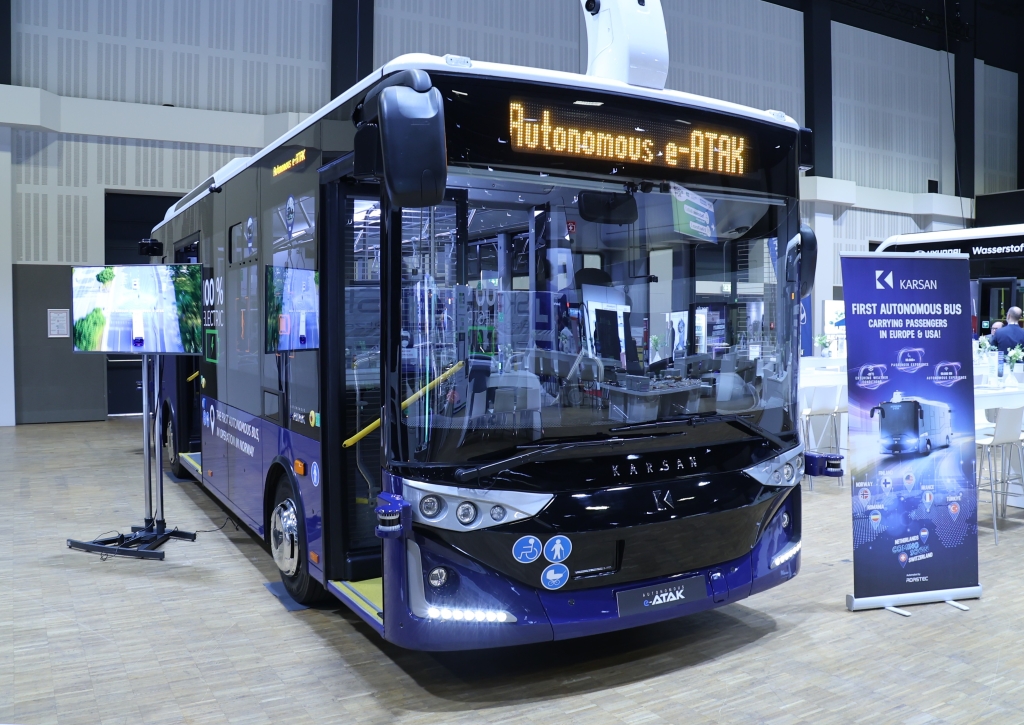
Karsan’s e-ATAK was first unveiled at Busworld 2019 in Brussels, followed later by the autonomous version | © Urban Transport Magazine
The autonomous driving system is supplied by ADASTEC, a specialist in automated mobility solutions for public transport. The software architecture combines high-resolution digital maps with rule-based, scenario-driven decision logic. Key functions include automated acceleration and braking, lane keeping, safe merging into traffic, and turning or avoidance maneuvers. Especially in complex urban situations—such as interactions with vulnerable road users or temporary obstacles—the system’s consistency, transparency, and adherence to safety margins are being carefully evaluated.
A central element of the tests is the assessment of system reliability under realistic operating conditions. This includes sensor performance under changing light and weather conditions, trajectory repeatability, and behavior in ambiguous traffic scenarios. MVG bus director Veit Bodenschatz emphasizes that the quality of environment interpretation and vehicle localization is crucial, as it directly affects the safety and public acceptance of automated buses.
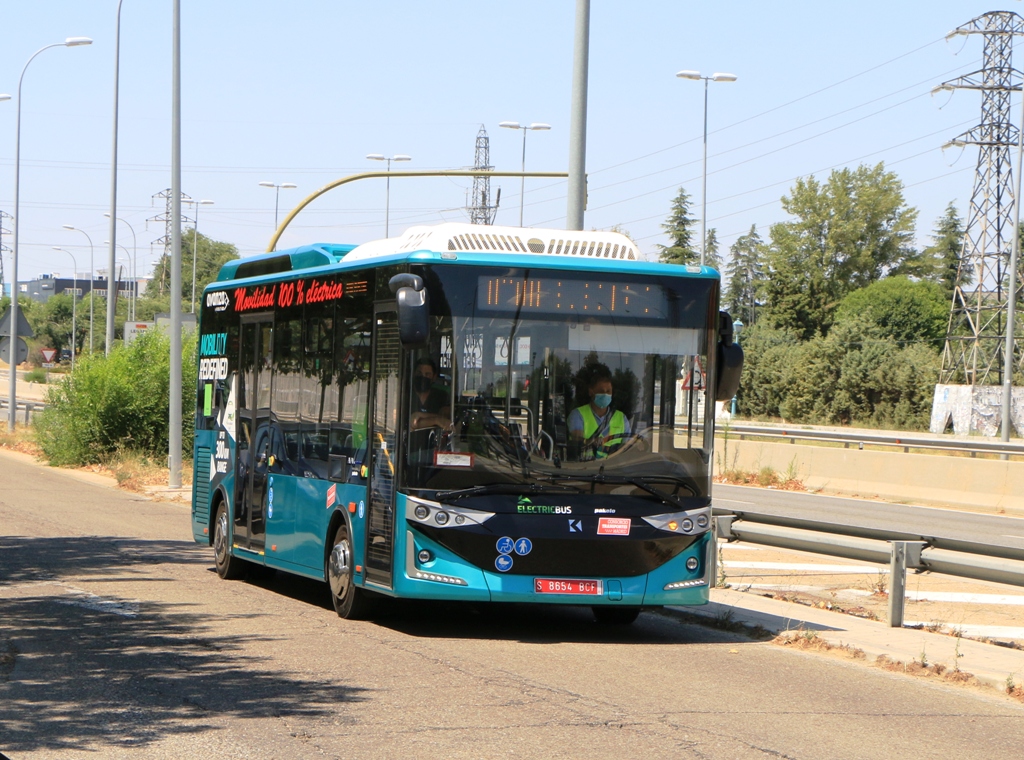
The e-ATAK is already being marketed throughout Europe as a city bus – here in use in Getafe near Madrid I © UTM/b
From a regulatory perspective, the tests operate within Germany’s legal framework for automated driving. Germany is one of the first countries worldwide to allow regular operation of vehicles with autonomous driving functions within defined operational domains. For public transport, this means that automated buses may eventually operate without a driver but under the supervision of a technical overseer, provided that approvals, safety concepts, and technical safeguards comply with legal requirements. Current trials are still conducted on a closed operational site to validate systems, processes, and safety architectures before any deployment on public roads.
MVG CEO Ingo Wortmann frames the tests as part of a long-term strategy focused on scalability and cost efficiency. MVG pursues a technology-neutral approach, evaluating automated vehicles of various sizes—from small on-demand shuttles to full-size line buses. Key considerations include how well automated systems can be integrated into existing operations, including control center interfaces, maintenance, staff training, and emergency procedures.

The autonomous e-ATAK at the IAA 2024 in Hanover | © Stefan Vogel
The current midibus trial complements previous tests with automated minibuses conducted in autumn 2025, as well as the MINGA project (“Munich Automated Local Transport”). This program will evaluate, among other things, an automated MAN solo bus, ridepooling vehicles, and bus-platooning concepts. Together, these initiatives cover a broad spectrum of potential automation applications—from low-demand feeder services to high-capacity line operations.
In the long term, SWM/MVG view automation as a strategic tool to address driver shortages, stabilize operating costs, and enhance service quality and schedule flexibility. The e‑ATAK trials provide crucial technical and regulatory insights and mark a further step toward a gradually automated urban bus network in Germany.
18.01.2026
Kaynak: https://www.urban-transport-magazin...g-block-for-future-automated-urban-transport/
Emirhan Sevdalı
WT Kullanıcı
